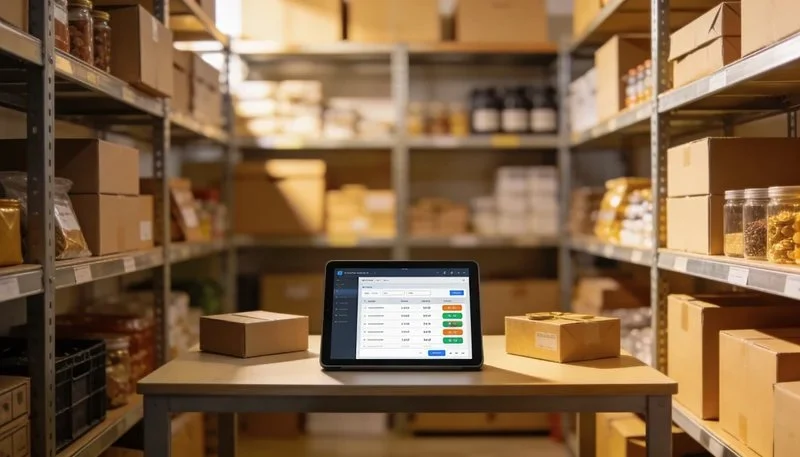
Customers no longer follow a single path to purchase. The same person browses a product on Instagram in the evening, compares it on a marketplace the next day, and finally places the order on your website because that is where it felt safest. Multichannel selling is not a trend to follow because everyone is talking about it; it is the logical result of how people actually behave. The problem starts when every channel works like a separate island: inventory does not match, prices differ, orders are copied over by hand, and behind it all is someone who spends every morning trying to reconcile the irreconcilable. In this article we break down what multichannel selling looks like when it is set up as a serious system rather than a pile of separate accounts.
What multichannel selling really means
Multichannel selling means you sell through several channels at once, but with a single source of truth behind them. The three most common pillars are your own online store, marketplace platforms and social media. Each has its own role and its own economics, so you need to understand them separately before you connect them.
- Your own online store is the only channel you fully control. That is where you define the look, customer data, marketing and margin without intermediaries.
- Marketplace platforms bring ready-made traffic and trust, but they take a commission and keep the customer relationship partly out of your hands.
- Social media is where products get discovered, and increasingly where the purchase itself happens, through integrated shops and product tags on posts.
The key difference from simply selling in several places is coordination. If a customer sees a product as available on one channel when it is actually sold out, the problem is not the channel, it is that the channels are not connected.
Why a central data source is unavoidable
The biggest mistake we see at growing companies is that every channel has its own product list, its own stock levels and its own version of the price. With twenty products and one channel, that works. Once you reach a few hundred items and three channels, manual upkeep becomes a source of errors and lost time.
The solution is a central system that holds one authoritative version of every piece of data. That can be your online store acting as the master, a separate product database or a dedicated product information management platform. What matters is that there is one place where you change a price, description or stock level, and that change automatically spreads to every other channel.
When we build systems like this, we usually set up the online store as the hub from which data flows to marketplaces and social media. If you need a more flexible approach because of specific processes, we connect a separate data management system through custom solutions tailored to your business.
Syncing inventory and orders
The heart of every multichannel system is inventory sync. Imagine you have five units of a product. If two sell on a marketplace in the same hour that three sell on your online store, and the channels do not talk to each other, you have sold eight units out of five available. That is not a theoretical risk; it is everyday reality for companies without integration.
If you plan to sell online, see what our ecommerce development looks like: payments, shipping and invoices ready from day one.
A well-designed system works on a simple principle: every sale on any channel immediately reduces the central stock level, and that new level is pushed back to every channel. The same goes for orders. Instead of staff checking three admin panels, all orders land in one place where they are processed, packed and shipped.
- A customer orders a product on any channel.
- The central system records the order and reduces the stock level.
- The new stock level is synced to all remaining channels.
- The order enters a single processing and fulfillment flow.
The goal is to keep the number of places where a person has to step in manually as small as possible, because every manual step is a potential error.
How the channels differ in practice
Although we aim for a single system, the channels are not identical and should not be treated as if they were. Each has a different logic of cost, control and customer relationship.
| Channel | Control | Cost | Main advantage |
|---|---|---|---|
| Your own online store | Full | Development and marketing | Margin and customer data |
| Marketplace | Limited | Commission per sale | Ready-made traffic and trust |
| Social media | Medium | Advertising and content | Discovery and reach |
A smart strategy uses marketplaces and social media to reach new customers, then gradually guides them toward your own online store, where the relationship is direct and the margin is higher. Your online store is therefore not just another channel, but a long-term asset of your business.
The technical foundation that holds it all together
Multichannel selling stands or falls on the quality of its integrations. Channels are usually connected through application programming interfaces (APIs) that let systems exchange data in real time. This is where reliability is decided.
What to watch for
- Product mapping. The same item needs a clear identifier across all channels, usually through a consistent SKU system.
- Error handling. When a channel temporarily stops responding, the system must know to retry instead of letting data quietly go stale.
- Pricing rules. Marketplace commissions may require different prices per channel, and the system should support that without manual calculation.
- Sync speed. Stock levels should update in seconds, not hours, because delays lead to selling goods you do not have.
A stable foundation matters more than the number of channels. It is better to have two flawlessly connected channels than five that keep breaking. Solid ecommerce development, with an online store designed from the start as the hub of a multichannel system, saves months of patching later.
How to build a multichannel system step by step
We do not recommend introducing everything at once. A multichannel setup is built in phases, and each phase must run reliably before you add the next.
- Set up a solid online store. It is the master everything starts from, so it needs a clean catalog and reliable inventory management.
- Add one marketplace. Learn the rhythm of syncing and order processing on one channel before expanding.
- Connect social media. Once the foundation works, integrated shops on social platforms become an extension of the same catalog.
- Measure and optimize. Track which channel delivers which margin and adjust your investment to actual results.
This approach reduces risk and keeps every mistake small and easy to fix. If you are planning this path, we can work through our range of services together to define the order that makes sense for your specific situation.
Multichannel selling is not a question of whether to be present in several places, but of how to turn that presence into a system that does not create chaos. The difference between a company drowning in three admin panels and a company growing calmly lies in the quality of the integration beneath the surface. When data is centralized, inventory is synced and orders are consolidated, adding a new channel becomes a growth decision rather than a new source of problems.