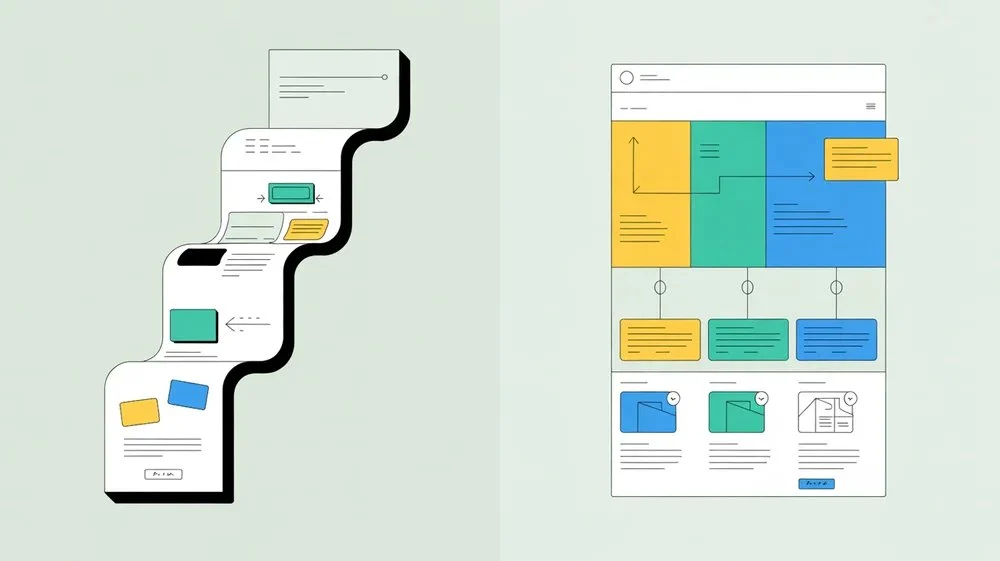
What are single-page and multi-page websites?
Before comparing the pros and cons, it is important to understand what each of these terms actually means in practice.
Single Page Application (SPA)
The entire website is a single HTML file. Content loads dynamically as the user scrolls or clicks the navigation, without reloading the page. Examples: a landing page, a portfolio, a promo page for an event.
Multi Page Application (MPA)
Each section or category is a separate page with its own URL. Clicking a link loads a new page with a new HTML document. Examples: a corporate website, an online store, a blog, a portal.
The difference is not just technical: it directly affects user experience, SEO opportunities and the long-term scalability of your online presence.
Advantages of a single-page website
The single-page approach was popularized by small businesses and freelancers who need a fast, visually striking web presence without a complex navigation structure.
-
Faster initial load: one page means fewer HTTP requests to the server on the first visit
-
Smooth user experience: no breaks between sections, navigation feels fluid and modern
-
Simpler to build and maintain: fewer files and fewer pages mean lower development costs for a smaller amount of content
-
Great on mobile devices: scroll-based navigation matches the natural way people use smartphones
-
A focused visitor: nobody gets lost in the navigation, visitors move through the content in the order you defined
Disadvantages of a single-page website
Despite their appeal, single-page websites have serious limitations that can be a deal-breaker for many businesses.
If you want people to find you on Google through organic search, a single-page website can be a serious obstacle for your SEO.
-
Limited SEO potential: a single URL means you can target only one keyword, which drastically reduces organic visibility
-
Not scalable: as your business grows and you add services, products or a blog, a single page becomes overcrowded and hard to manage
-
Poor analytics segmentation: without separate URLs it is harder to track which sections attract visitors and where you lose them
-
Sharing a link to a specific section: a visitor you send to the “About us” section always starts at the top of the page
Advantages of a multi-page website
Multi-page architecture is the standard for serious business websites, and that is no accident. This approach is the basis of successful SEO for better Google rankings and long-term online growth.
-
Full SEO potential: every page can rank for its own keyword, which means many more channels for organic visitors to find you
-
Unlimited scalability: add new services, categories, blog posts or locations without restructuring the whole site
-
Clear structure and navigation: users know where they are on the site and easily find exactly what they are looking for
-
More detailed analytics: track the performance of each page separately, identify your most popular content and optimize conversions
-
Reliability: if one page has a problem, the rest of the site keeps working normally
Disadvantages of a multi-page website
Multi-page websites are not perfect for every situation. There are scenarios where their complexity can be more of a burden than an advantage.
-
Higher initial development cost: more pages mean more design, development and testing in the first build
-
Slower navigation between pages: every click loads a new page, which can be noticeable if the server or hosting is not optimized
-
More demanding maintenance: site-wide changes (header, footer, design) must be applied consistently across all pages
In most cases, the slow-loading drawback of multi-page websites is successfully solved with technical optimization, caching, a CDN and image optimization. Quality development includes these steps as well.
If you are thinking about a new or better website for your company, see how we approach website development for clients in Sarajevo and across Bosnia and Herzegovina.
Comparison table: SPA vs MPA
To make the decision easier, here is a direct comparison of both approaches based on the key criteria that matter to businesses in Bosnia and Herzegovina.
| Criterion | Single Page (SPA) | Multi Page (MPA) |
|---|---|---|
| SEO potential | Limited | Excellent |
| Loading speed | Faster (first load) | Good (with optimization) |
| User experience | Smooth, modern | Clear, intuitive |
| Scalability | Limited | Unlimited |
| Suitable for a blog | Not recommended | Ideal |
| Suitable for an online store | Not recommended | Ideal |
| Initial cost | Lower | Higher |
| Long-term value | Limited | High |
When should you choose a single-page and when a multi-page website?
It is not always black and white: the context of your business plays a key role in choosing the right solution.
A single-page website is a good option if:
-
You have only one product or service and a clearly defined target audience
-
You are creating a landing page for a specific campaign or event (e.g. a conference, a promotion, an app)
-
Your main source of visitors is not Google search but social media or paid advertising
-
You are building a portfolio or creative showcase where visual impact matters more than depth of information
A multi-page website is the right choice if:
-
You want customers to find you organically on Google for different keywords
-
You offer several services or product categories that deserve their own page with descriptions
-
You plan to launch a blog or news section, or to add new content regularly
-
You are building an online store for your company with many products and categories
-
You are thinking long term about growing your company and its online presence, since every new page is a new SEO asset
What is the smarter choice for businesses in Bosnia and Herzegovina?
Experience working with local companies shows one important thing: most small and medium-sized businesses in Bosnia and Herzegovina make the same mistake. They launched a simple single-page website because it was “cheaper and faster”, and now they wonder why they are nowhere on Google while competitors with multi-page sites receive inquiries every day.
“A website is not an expense, it is a sales channel. And like any channel, it needs to be set up to deliver results, not just to exist.”
NEVIS team
Companies in Sarajevo, Banja Luka, Tuzla and Mostar that want to attract customers through Google search (whether they offer construction services, accounting, hairdressing or sell goods) need a multi-page website that lets them show up for specific local searches like “plumber Sarajevo” or “beauty salon Banja Luka”.
On the other hand, if you are running a specific promotional campaign through digital marketing and advertising on social media, a well-designed single-page landing page can be exactly the right solution for that purpose.
The hybrid approach: the best of both worlds
Many businesses successfully combine both approaches: they have a multi-page website as their primary online presence and also create separate single-page landing pages for specific campaigns or promotions. This gives them both the SEO advantages and flexibility in their marketing activities.
Conclusion: site architecture is a strategic decision
Choosing between a single-page and a multi-page website is not just a technical preference, it is a strategic decision that affects your growth in the years ahead. Single-page websites are a great tool for certain purposes, but for businesses that want long-term organic visibility and scalability, the multi-page approach almost always delivers a better return on investment.
Whichever type you choose, the key is that the website is professionally built, technically optimized and aligned with your business goals. A poorly executed SPA or MPA will deliver equally poor results.